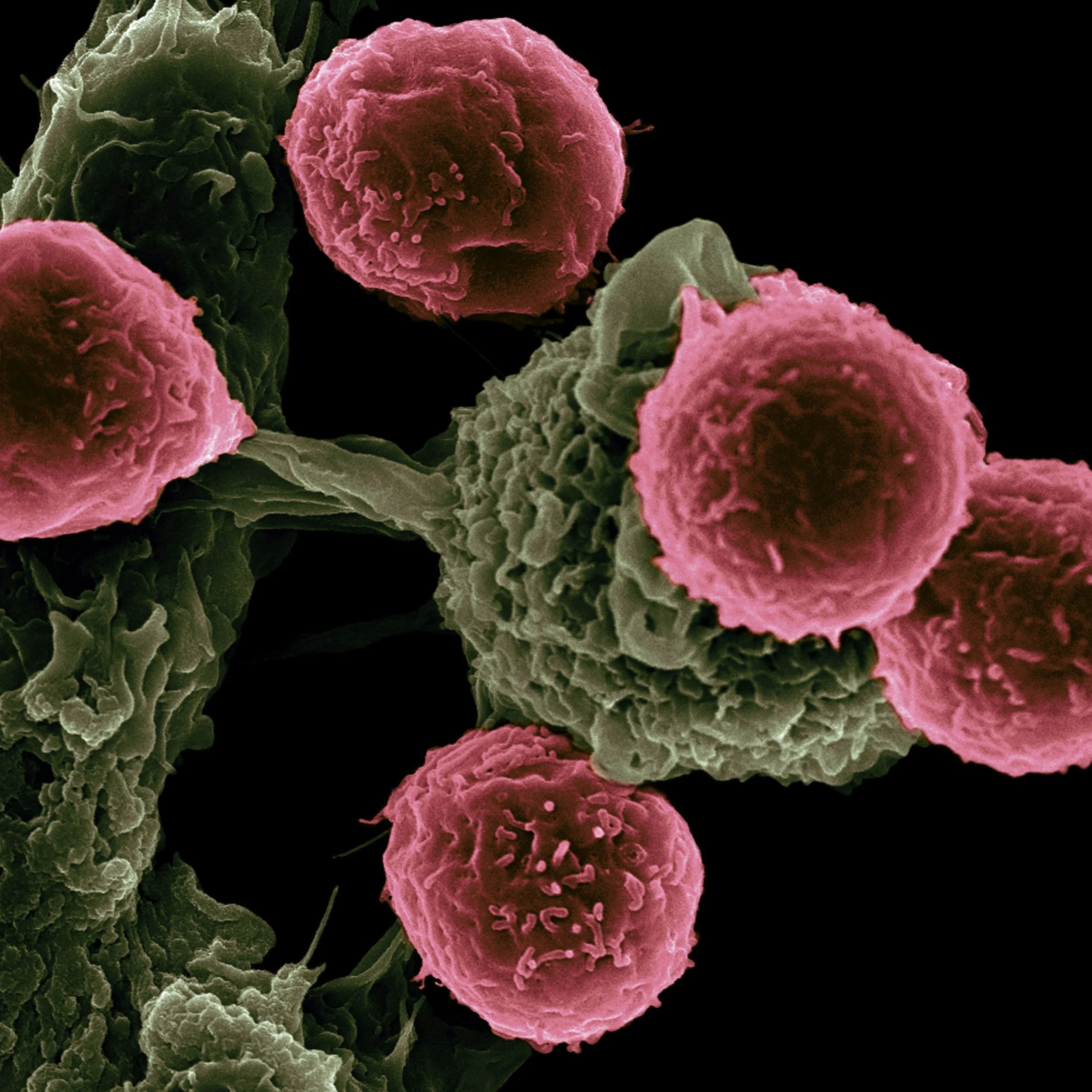
Cancer Research & Surgical Innovation
Advancing Cancer Care Through Science and Innovation
Translational Research Connecting Discovery to Patient Care
My work as a surgical oncologist is closely connected to laboratory discovery, translational cancer research, and national clinical collaborations focused on improving outcomes for patients with complex cancers. This scientific foundation also informs the thoughtful adoption of advanced robotic and minimally invasive surgical techniques when they can enhance precision, recovery, and overall treatment strategy.
Progress in cancer treatment depends on the integration of scientific discovery with clinical care. My research focuses on understanding cancer at its most fundamental biological levels and translating those insights into more effective, personalized treatments for patients.
This work includes investigations into tumor biology, mechanisms of cancer spread, and the behavior of tumor-initiating cells, as well as the development and evaluation of innovative surgical and technology-enabled therapies. By bridging laboratory science, clinical research, and surgical practice, the goal is to improve outcomes, expand treatment possibilities, and refine how cancer care is delivered.
Every advance in cancer care begins with a question — and a commitment to finding better answers for patients.
How My Research Informs Patient Care
My research career has focused on understanding how cancers grow, spread, and respond to treatment at the cellular and molecular level. This scientific foundation directly shapes how I care for patients today.
Understanding Tumor Biology
Research on tumor-initiating cells and cancer signaling pathways helps explain why some tumors behave aggressively while others grow slowly. This supports thoughtful treatment planning, including when surgery should be combined with systemic or targeted therapies.Translational Approach to Cancer Care
Work in stem cell biology and tumor microenvironments emphasized how cancer cells interact with surrounding tissues and blood vessels. These principles influence how we evaluate tumor resectability, plan operations safely, and coordinate care with oncology specialists.Commitment to Evidence-Based Surgery
Participation in national research collaborations reinforces a practice grounded in clinical trials, biologic understanding of disease, and national guideline-based care.Multidisciplinary Decision Making
A research background fosters close collaboration across specialties so that each patient’s plan reflects the most current scientific knowledge.Innovation with Safety
Advanced robotic and minimally invasive techniques are adopted carefully and responsibly, with a focus on outcomes, risk evaluation, and oncologic safety.
Selected Research Funding & National Awards
Dr. Krampitz’s research has been supported by nationally competitive grants and foundations dedicated to advancing cancer biology and translational medicine. These awards supported collaborative research at leading academic institutions and contributed to advances in cancer biology and translational surgical science.
Stand Up To Cancer (SU2C) – Lustgarten Foundation Pancreatic Cancer Dream Team
Co-Investigator | 2014–2017California Institute for Regenerative Medicine (CIRM) – New Faculty Award II
Co-Investigator | 2008–2013Howard Hughes Medical Institute (HHMI) Medical Research Fellows Program
Co-Investigator (2006–2007) | Mentor (2014–2015)A.P. Giannini Foundation Fellowship for Medical Research
Investigator | 2012–2015American College of Surgeons (ACS) Research Fellowship
Investigator | 2013–2015Stanford Medical Scholars Research Grant
Co-Investigator | 2003–2004
Key Research Focus Areas
Tumor-initiating cells and cancer stem cell biology
Pancreatic neuroendocrine tumor biology and targeted therapies
Mechanisms of cancer progression and metastasis
Tumor microenvironment and vascular signaling pathways
Translational surgical oncology and outcomes research
Selected Peer-Reviewed Publications
Below is a selection of peer-reviewed scientific publications that have contributed to current understanding of cancer biology, surgical oncology, and tumor behavior.
Identification of Tumorigenic Cells and Therapeutic Targets in Pancreatic Neuroendocrine Tumors
PNAS. 2016.
Link: PubMed
Skin Fibrosis: Identification of a Dermal Lineage With Fibrogenic Potential
Science. 2015.
Link: PubMed
Surgical Adhesions in Mice Are Derived From Mesothelial Cells
Sci Transl Med. 2018.
Link: PubMed
Margin-Positive Pancreatic Ductal Adenocarcinoma During Pancreaticoduodenectomy: Additional Resection Does Not Improve Survival
Ann Surg Oncol. 2021.
Link: PubMed
Association of Mutant KRAS Alleles With Morphology and Clinical Outcomes in Pancreatic Ductal Adenocarcinoma
Arch Pathol Lab Med. 2024.
Link: PubMed
Additional Peer-Reviewed Publications
Euglycemic Diabetic Ketoacidosis (EDKA) After Pancreaticoduodenectomy
Surgery. 2023.
Link: PubMed
ASO Author Reflections: Margin-Positive PDAC During Pancreaticoduodenectomy
Ann Surg Oncol. 2020.
Link: PubMed
Staging of Biliary and Primary Liver Tumors: Current Recommendations and Workup
Surg Oncol Clin N Am. 2019.
Link: PubMed
Preoperative Drainage for Perihilar Cholangiocarcinoma
Lancet Gastroenterol Hepatol. 2019.
Link: PubMed
Prospective Evaluation of Results of Reoperation in Zollinger-Ellison Syndrome
Ann Surg. 2018.
Link: PubMed
Multiple Endocrine Neoplasia: Genetics and Clinical Management
Surg Oncol Clin N Am. 2015.
Link: PubMed
Better Survival But Changing Causes of Death in MEN1
Ann Surg. 2015.
Link: PubMed
RET Gene Mutations in MEN2 and Familial Medullary Thyroid Carcinoma
Cancer. 2014.
Link: PubMed
Man With Hypoechoic Lesion Abutting the Pancreas
JAMA Surg. 2014.
Link: PubMed
Current Management of the Zollinger-Ellison Syndrome
Adv Surg. 2013.
Link: PubMed
Pancreatic Neuroendocrine Tumors
Curr Probl Surg. 2013.
Link: PubMed
Pancreatic Neuroendocrine Tumours: Hypoenhancement Predicts Aggressiveness
HPB (Oxford). 2014.
Link: PubMed
Lymph Nodes and Survival in Pancreatic Neuroendocrine Tumors
Arch Surg. 2012.
Link: PubMed
Hypoxia-Inducible Factor–Dependent Histone Deacetylase Activity in Placental Stem Cells
Development. 2005.
Link: PubMed
Book Chapters
Staging of Biliary and Primary Liver Tumors – Surgical Oncology Clinics of North America, 2019
The Spleen and Adrenal Glands – Hepatobiliary and Pancreatic Surgery, 6th Ed., 2018
Exploration of the Gastrinoma Triangle – Atlas of Upper GI & HPB Surgery, 2016
Afferent Loop Syndrome – Gastrointestinal Surgery Complications, 2015
Discovery of RET Proto-Oncogene in MEN2 – Narrative History of Endocrine Surgery, 2013
Pancreatic Neuroendocrine Tumors – Current Problems in Surgery, 2013
Zollinger-Ellison Syndrome – Surgery: Evidence Based Practice, 2012
Gastrinoma (MEN I) – Clinical Scenarios in Surgery, 2012
Research Abstracts & Presentations
Western Surgical Association (2018) – Vascular anatomy in hilar cholangiocarcinoma resection
Society of Surgical Oncology (2017) – Tumorigenic cells in pancreatic NETs
NANETS Annual Symposium (2015) – Tumorigenic cells in pancreatic NETs
AACR Pancreatic Cancer Conference (2014) – Anti-CD47 therapies
Pacific Coast Surgical Association (2012) – Lymph nodes in pancreatic NETs
From Discovery to Patient Care
Scientific discovery and surgical innovation are deeply connected — and both inform the care I provide to every patient facing a complex cancer diagnosis. My goal is to translate what we learn from tumor biology, clinical outcomes research, and national collaborations into practical decisions that improve safety, recovery, and long-term cancer control. When surgery is recommended, it is guided by evidence and integrated with multidisciplinary care so that each plan is tailored to the biology of the disease and the needs of the person.